
Pool Resurfacing in Houston: Signs, Finish Options & Cost Factors
By Action Custom Pools · Houston Pool & Outdoor Living Builder
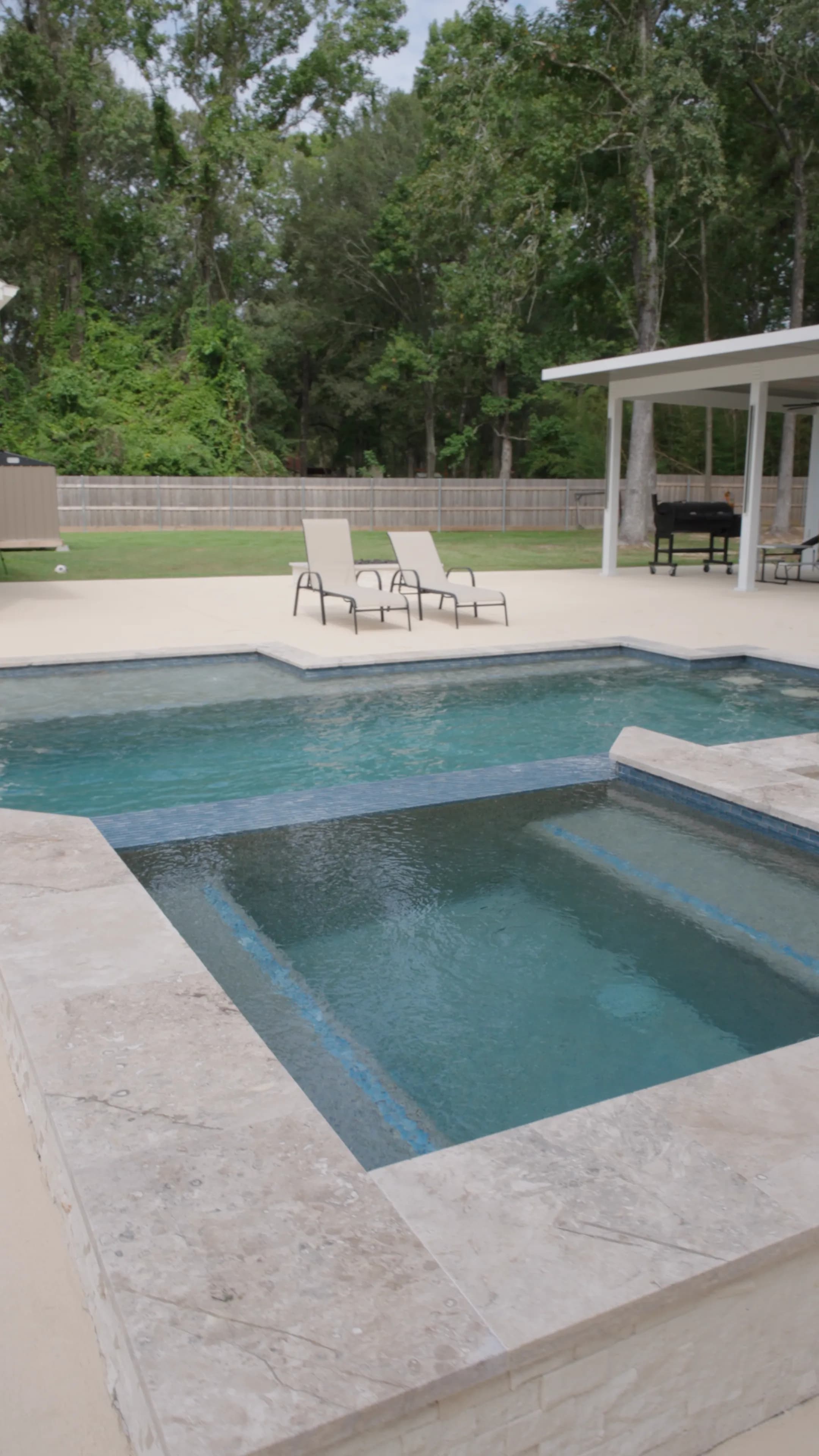
Most pools in the Houston area are built in gunite, and every gunite pool has the same weak point: the thin interior finish troweled over the shell. It is what your feet touch, what colors the water, and what keeps the concrete underneath sealed. It also wears out long before the structure does. Resurfacing replaces it, and for an older pool it is usually the single change that makes the biggest difference in how the pool looks and feels.
This guide covers how to tell when your finish is done, how the three main finish families compare, when a resurface should become a larger renovation, and what actually drives the price.
Signs Your Pool Needs Resurfacing
A finish rarely fails all at once. It degrades over several seasons, and the early signs are easy to write off as a cleaning problem. Walk the pool with these in mind:
- Rough texture. The floor feels like sandpaper, children come out with scraped toes, and swimsuits pill or snag on the steps and benches.
- Stains that come back. Brushing and chemical treatment lighten them, then they return in the same spots within weeks.
- Etching and pitting. Small craters and a chalky, eroded surface, often worst on the steps and around the main drain where water moves fastest.
- Flaking or hollow spots. Patches that sound hollow when tapped, or that have already peeled away from the shell.
- Gray showing through. Dark spots where the finish has worn thin enough to expose the gunite beneath it.
- Spreading cracks. A web of fine surface cracks that grows each year. A single wide or displaced crack is different and needs to be assessed as a possible structural issue first.
If the pool is also losing water faster than evaporation explains, have it checked for a leak before anything else. A new finish will not fix a broken pipe, and a leak is far easier to locate and repair while the pool is being worked on than after it has been refilled.
Houston conditions speed all of this up. A long swim season keeps the pool in heavy use, summer water runs warm, and a few inches of rain in an afternoon can dilute the water and knock the chemistry out of balance. Water that stays aggressive, low in calcium or pH, slowly dissolves the finish from the surface down.
Finish Options: Plaster, Quartz, and Pebble
Nearly every residential resurface in the area uses one of three cement-based finish families. They are applied the same basic way and differ mainly in what is mixed into the cement.
Plaster is the traditional finish: smooth, bright, and classic white unless it is tinted. It is the least expensive of the three and the softest underfoot, and it is also the shortest-lived, because a smooth cement surface shows etching and staining first.
Quartz blends crushed quartz aggregate into the plaster. The result is harder and more resistant to staining and etching than plain plaster, still smooth to the touch, and available in far more colors. For many homeowners it is the middle ground between price and life span.
Pebble finishes use small, rounded stones set in cement and then exposed so the stone forms the surface. Pebble has the most natural look and the longest service life of the three. It has a textured feel that some people love and others need to try first, which is why it is worth standing on a wet sample before you choose.
Whichever family you pick, the finish color sets the color of the water. White plaster reads as pale, bright blue; darker quartz and pebble shift the water toward deep blue, lagoon green, or a gray-blue that suits modern architecture. Samples should be judged wet and in daylight, never from a printed brochure. Our pool resurfacing and replastering service page compares the three side by side, including the 2026 Houston-market ranges for each.
Thinking About a Project Like This?
Tell us about your backyard and what you have in mind. We will follow up to talk through options and next steps.
Resurfacing vs. a Full Renovation
Resurfacing replaces the interior finish and nothing else. If the shell is sound, the equipment works, and you are happy with the layout, that may be all the pool needs.
In practice, the drained pool is the cheapest moment to fix everything else at the waterline, so a resurface often picks up a few related items:
- Waterline tile. Older tile that is chipped, scaled with calcium, or simply dated will make a brand-new finish look unfinished.
- Coping. Cracked or loose coping stones are reset or replaced while there is no water against the beam.
- Lights and fittings. Returns, drains, and light niches are reset to the new surface, and it is a natural time to switch to LED lighting.
When the list grows to include a new deck, new equipment, a tanning ledge, an added spa, or a change to the pool's shape, the project has become a remodel and should be designed and priced as one. Our full pool renovation and remodeling page covers that larger scope. Resurfacing and tile work are cosmetic and typically do not need a permit, but structural changes and new gas or electrical service usually do; the Houston and Harris County pool permit guide explains how that works in each jurisdiction.
What Drives Pool Resurfacing Cost
Two pools with the same footprint can come in at very different prices, because a resurface is priced on more than the size printed on the original plan. These are the factors that move the number:
- Interior surface area. Finish is priced on every square foot it covers, not on the water's footprint. Depth, steps, benches, tanning ledges, and an attached spa all add surface that a simple length-by-width figure misses.
- The finish family. Plaster, quartz, and pebble are priced differently, and within each family, premium colors and aggregates cost more than standard ones.
- The condition of the old surface. How much failed material has to be removed, how many hollow spots and cracks need repair, and whether the pool has been resurfaced before all affect preparation time, which is a large share of the labor.
- Tile and coping. Replacing them at the same time adds material and labor, but costs less than doing the work as a separate project later.
- Fittings, lights, and equipment. Resetting existing fittings is part of a normal resurface. Replacing lights or upgrading the pump, filter, or automation adds to the scope.
- Access and site conditions. How easily the crew can reach the pool, and how the water can be drained after a wet stretch of Houston weather, both shape the schedule.
It also helps to think about cost over time rather than only on day one. A longer-lasting finish costs more up front, but if it delays the next resurface by several years, its cost per year of service can be lower than a cheaper finish's. Asking for each option to be priced on the same quote makes that comparison easy.
Published ranges are a starting point for a budget; the number that matters is the one measured from your pool. Every Action Custom Pools quote is free and itemized, so you can see what each item adds. For new-construction pricing, see our Houston Pool Cost Guide.
The Resurfacing Process and Timeline
A resurface follows the same sequence on almost every pool:
- Assess and quote. The finish, tile, coping, and shell are inspected and the pool is measured.
- Choose the finish. You select the finish, color, and any new tile and coping from physical samples.
- Drain and prepare. The pool is drained, the old surface is prepared so the new one bonds to sound material, and cracks and hollow spots are repaired.
- Tile and coping. Any new waterline tile and coping are set before the finish goes on.
- Apply the finish. The new finish is applied by hand in one continuous application.
- Fill and start up. The pool is filled without stopping, the water is balanced, and the new surface is brushed through its startup period.
The whole project is measured in weeks rather than months. Weather is the main variable in Houston: application day needs a dry window, and draining after heavy rain has to account for groundwater around the shell. Fall through early spring is the easiest season to schedule, as our article on the best time of year to resurface a pool in Houston explains. You receive a written schedule for your project before the pool is drained.
Getting Your Pool Assessed
If your pool is showing two or three of the signs above, it is time to have the surface looked at in person. We will inspect the finish, tile, and coping, tell you whether a resurface is enough or a remodel makes more sense, and price the options side by side. Request a free resurfacing quote or call (713) 670-6671.
Frequently Asked Questions
Thinking About a Project Like This?
Tell us about your backyard and what you have in mind. We will follow up to talk through options and next steps.
More From the Blog
Start Planning Your
Outdoor Project.
If you are ready to create a custom pool or outdoor space designed around the way you live, we would love to help.
Prefer to talk it through? Call (713) 670-6671